
Case Study: The Definitive Guide to Getting Clients Through a Podcast in
The same three-step process I’ve deployed for hundreds of businesses to generate pre-sold clients on demand.
What’s Inside:
My good friend (and client) Mark runs an exclusive mastermind, called the Deal Maker Family.
And when I say exclusive, I mean it. It comes with a hefty price tag.
I won’t share the exact amount, but it’s a big dollar commitment for someone to make – closing a deal of that size is no small feat.
For most business owners, it would mean multiple one-on-one sales calls with the lead, meticulously strategic follow-up, and some downright magical persuasion tactics.
But not Mark. He enrolls people before they even book a call with him – simply by having a podcast. Check it out:
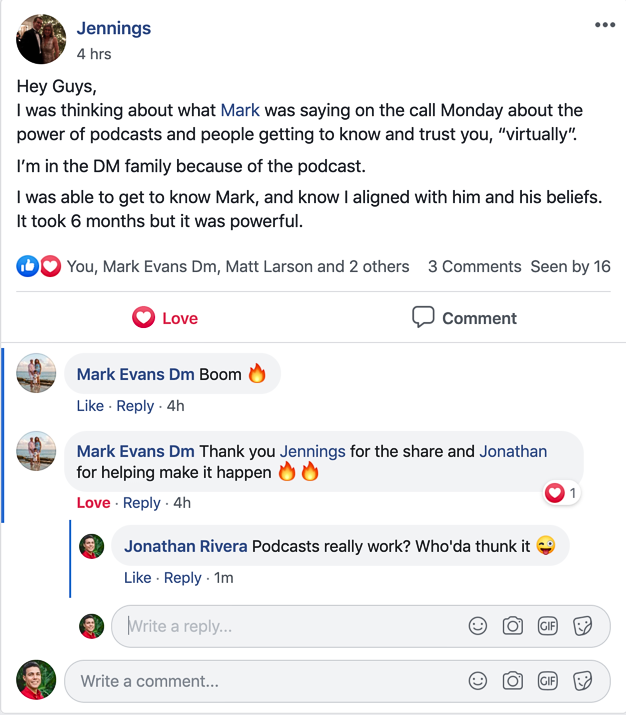
Jennings is one of Mark’s DM Family members. He specifically credits the podcast with getting him over the line; it’s what allowed him to feel comfortable enough to put his full trust in Mark, and take that leap.
So how does Mark do it?
How is he able to use a podcast to bypass the usual sales call headaches, and exclusively deal with pre-sold leads?
He uses my Direct Response Podcasting System™. It’s a simple three step strategy that ensures every single episode he puts out hits deeply with his perfect-fit audience.
It’s a method that me and my team have taught to hundreds of business owners. From newbies to advanced podcasters, it works like a charm every time.
And today, I’m going to show you exactly how we do it.
Quick side note before we dive in: if you’re interested in starting a podcast but don’t know where to start, me and my team offer a completely done-for-you service. We not only implement our Direct Response Podcasting System™, but will manage all areas of podcast creation – from supplying you with tech to world-class production.
You can click here to book a call with me, and learn more about what we can achieve for your business. Make sure to keep reading to find out what Direct Response Podcasting is, and how my system works.
Podcasting And The Power Of Connection: Why You Need To Start A Podcast
Before we get into the weeds with the technicalities of my Direct Response Podcasting System™ , I think it’s important that we look at the marketing potential of podcasting in a more broad sense.
Or in other words, why should you even consider dipping your toes into this world to begin with?
At the risk of over-simplifying it, podcasts are a power-packed marketing tool thanks to one thing: their capacity to spark a deep connection between host and listener.
Think about how we connect with people in the real world: through conversations, storytelling, and the sharing of ideas, thoughts, feelings, knowledge, and experiences.
Podcasting hits all of those same notes – just virtually rather than face-to-face.
Now, other forms of marketing content can also do these things, but nowhere near as effectively.
The verbal aspect of podcasts knocks all other mediums out of the water; it means you can mimic real-world connection building almost 1 for 1.
So how does this connection translate to marketing and sales? Let’s go back to that Facebook post by Mark’s client for a second:
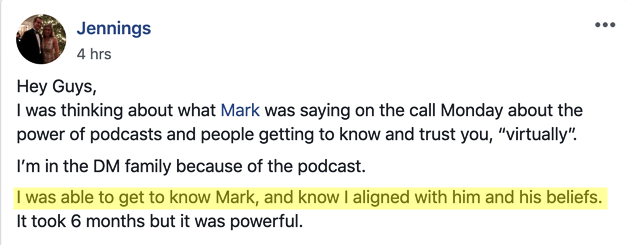
The connection that Mark was able to build with his audience, through his podcast, is ultimately what sold Jennings on his offer.
It’s what made him feel confident enough in Mark’s expertise that he willingly invested a hefty amount – with zero regrets.
Connection turns listeners into fans, and fans into customers. It’s that simple.
But despite the simplicity of that progression, many of those who step into the podcasting world end up failing to achieve it.
Most Podcasts Fail To Convert Listeners Into Customers: Here’s Why
In my mind, there are three key reasons why a podcaster may fail to bridge that gap from casual listener to raving customer:
1. They don’t have a vision of the audience they’re trying to speak to.
Mistake number one is that they don’t think about who they’re trying to speak to, before they speak.
This is a major foundational issue that bleeds into all other aspects of a podcast.
Because when you don’t know who your audience is, you don’t know what matters to them; what excites them, what pains them, what ignites their curiosity.
You’ve got zero intel on how to build that all-important connection.
2. They don’t know what they want their audience to do.
Obviously, the ultimate goal of marketing via podcast is to get your listeners to buy whatever it is you sell (duh).
But you and I both know that not everyone is willing to dive headfirst into your funnel, and go straight from cold lead to sales call.
And this is something most podcasters tend to overlook – they don’t consider that some listeners will move slower than others, and thus don’t provide a gentler path forward.
3. They don’t know how to move listeners towards that goal.
The final mistake directly flows from the first one:
When you don’t know who you’re speaking to, you can’t form a connection with them.
And without that connection, there’s no trust. How are you meant to convince listeners to follow you towards your end goal if they have no faith in you or your skill?
Long story short: to give yourself the best possible chance of connecting with your audience, you must plan around these pitfalls.
So, how exactly do you do that?
Well, in a segue that I’m sure absolutely no one reading this could’ve seen coming, this is exactly what my Direct Response Podcasting System™ is designed to do.
It gives you a blueprint to take those three ‘don’t know’s, and flip them on their head:
- You will understand your audience inside-out,
- You will have a clear goal for where you’re trying to lead them, and
- You will know exactly how to get them there
This system is the exact process I took Mark through – it’s how he was (and still is) able to create killer podcast content that easily brings in clients just like Jennings.
Direct Response Podcasting: What Is It And How Does It Work?
To sum it up in a single phrase, Direct Response Podcasting is evergreen educational marketing content.
It utilizes value-rich podcast content to pre-sell your offer to your perfect audience; it educates them on who you are, what you do, and the problems you solve.
This strategy gives you the tools to seamlessly guide your target market from stranger to raving customer, all in a matter of podcast episodes.
Let me break it down for you with a visual analogy:
The Podcast Pathway
I want you to picture a path, with a defined start and end point – something like this:

- Point A represents your ideal client. They are a perfect fit for your offer – they just don’t know it yet.
- Point B is your offer. To be a little more specific, it represents the wholehearted acceptance of your service.
So naturally, the space between is the path your leads must take to go from knowing nothing about who you are and what you do, to enthusiastically jumping on board and becoming a customer.
Take a minute to think about what the path between those two points would realistically look like.
It’s pretty rare that it would be a clear road; someone moving from A to B would have a lot of hesitations, objections, questions, and concerns.
“Do I trust this person’s ability? Is working with them worth the time and money? Would a service like this improve my life anyway?”
So with that in mind, let me tweak that image a bit.

That’s a bit more accurate, right? Going from cold lead to raving customer is a bumpy, prickly path, full of roadblocks and obstacles.
Logically, you want to clear that path as best you can to make it more appealing for people to take – this is what we want your podcast to do:
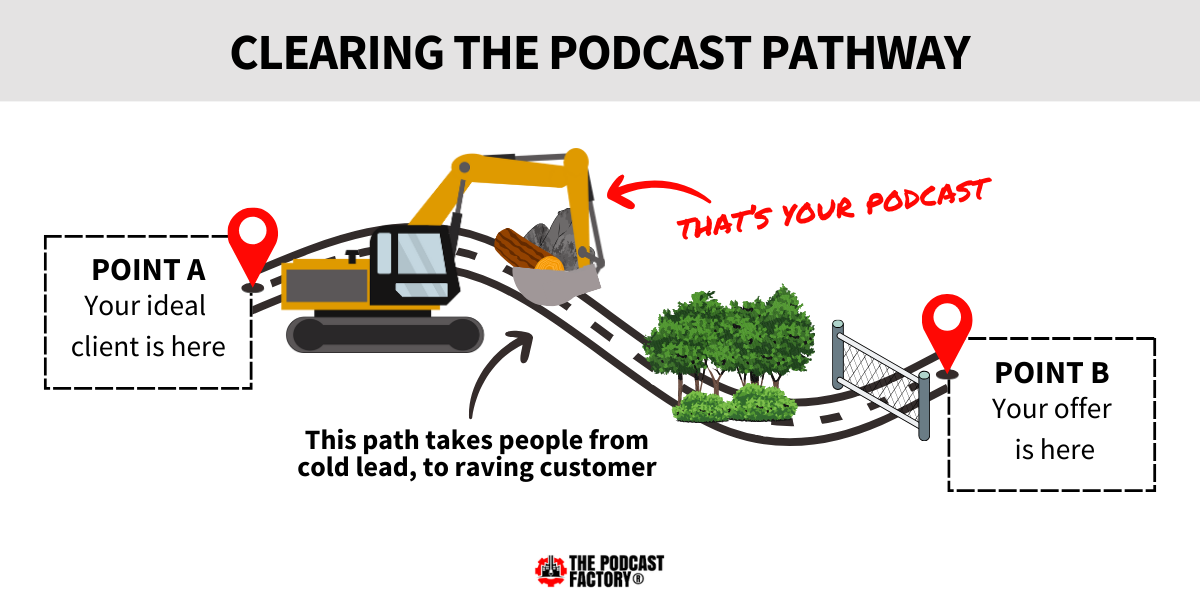
This path clearing is something that you already do on sales calls; it’s when someone hops on a call, still needing to be convinced.
When you have to explain who you are and what you do, why you’re better than your competitors, why your service costs as much as it does – that’s path clearing.
And it sucks.
Direct Response Podcasting lets you clear the path, before leads interact with you.
My system allows you to:
- Showcase your knowledge and expertise,
- Demonstrate your problem-solving capabilities,
- Provide new insights and perspectives to your audience,
- Build trust and connection, and
- Get the right people scrambling to work with you.
Let’s go back to Mark again for a minute – notice that in his post, Jennings said “it took 6 months” for him to feel fully confident in joining Mark’s mastermind.
Now, let’s be real – legit mastermind groups are expensive. Not many people can drop the money to join them with no hesitation. Most of us would instinctively think of a lot of reasons why not to do it.
So it’s not surprising that it took Jennings that amount of time to think it through. When we’re talking big money, objections and mental blocks are inevitable.
But therein lies the beauty of Direct Response Podcasting.
Episode after episode, Mark shared his knowledge, connected with his audience, and earned their trust and respect.
Jennings was able to just simply listen to Mark’s content, hear him speak directly to his problems and concerns, and have those mental barriers broken down for him.
When he did reach out to Mark, he’d already decided what he wanted – he was pre-sold, ready to go.
Mark did no hard-selling, no arm twisting, no rigorous follow-up – he just simply made his podcast, and people naturally made their way to where he wanted them to go, when they were ready.
Just a quick reminder: if you want me and my team to take you through the Direct Response Podcasting System™ and manage your podcast completely for you, (just like we did for Mark) you can click here to book a call.
How To Put It Into Action: The Three Steps Of The Direct Response Podcasting System™
The Direct Response Podcasting System™ is made up of three steps – each of which correlates to a point on the Podcast Pathway:
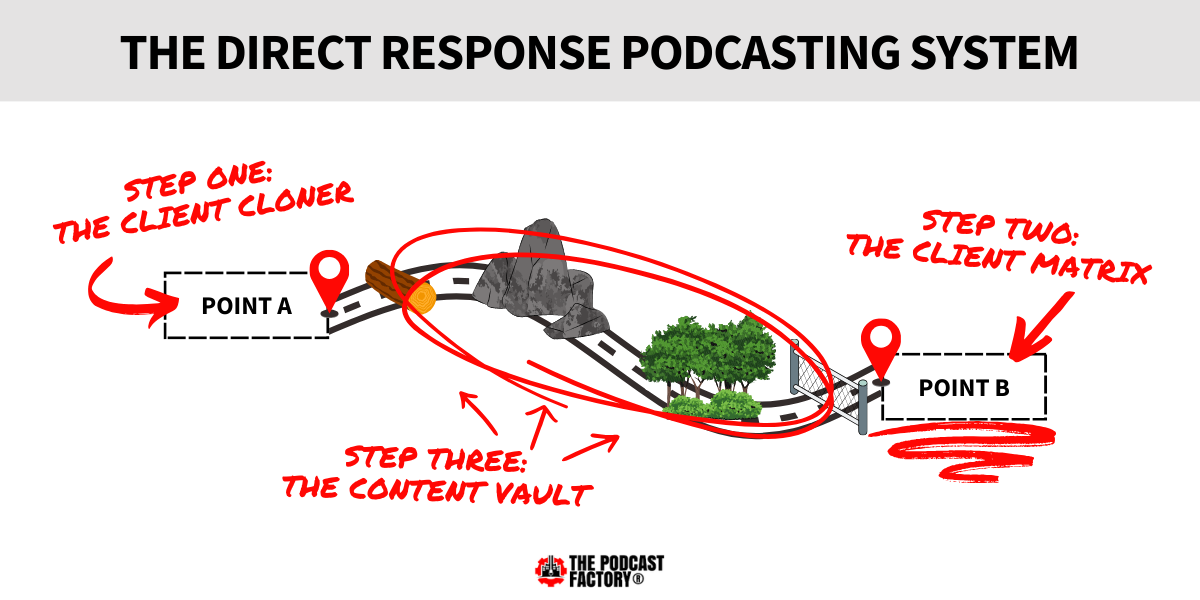
The purpose of this system is to ensure you can create podcast content that:
- Is tailored to the wants and needs of your perfect-fit audience,
- Completely dismantles their objections through building trust and connection, and
- Points listeners in the direction you want them to go.
Think of these three steps as the key that unlocks all of the marketing and sales potential that podcasting holds.
Remember: there are the same three steps that have allowed Mark (and hundreds of others) to unleash that podcasting power in his own business, and get people fighting for a spot in his mastermind.
Step 1: The Client Cloner – Pinpoint Your Ideal Client, And Replicate Them Over And Over Again
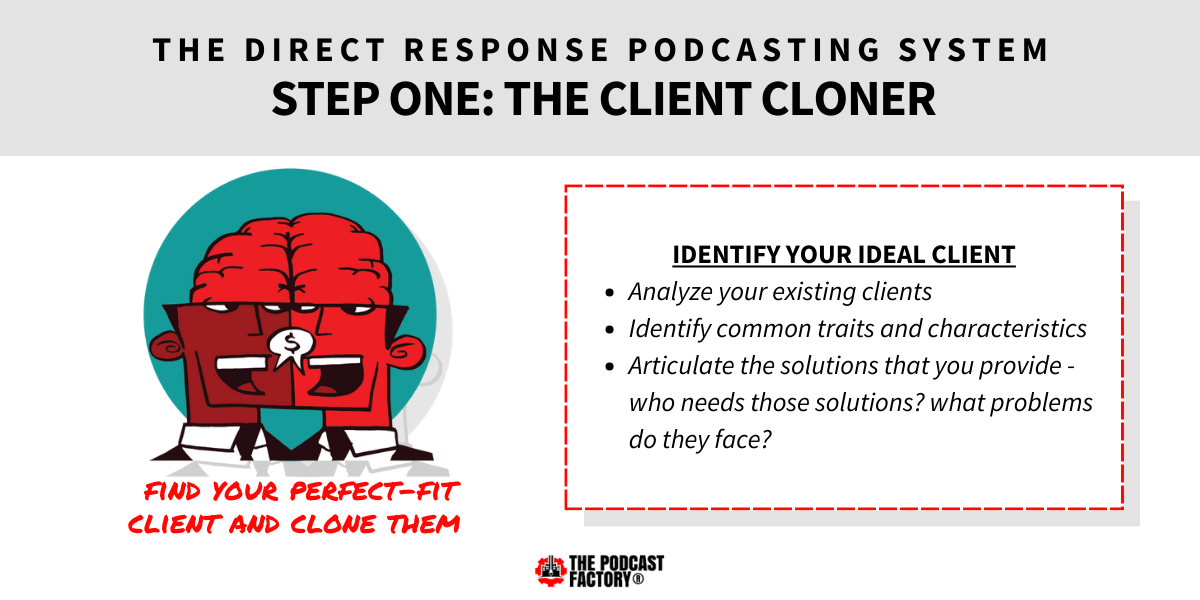
The first step I take all my clients through is to get their target audience nailed down.
And the more specific you can be now, the easier time you’ll have going through the rest of the system.
That little caveat can feel counterintuitive for a lot of people – getting specific about who you’re aiming for inherently means narrowing your potential audience.
Which in turn, means you’re reducing the number of people you can sell to, right?
Well, technically yes – but it’s not as bad as it sounds. Zeroing in on a smaller audience actually gives you a higher listener-to-customer conversion rate (when you do it right).
See, your offer is perfect for someone – but not everyone. The more wholly you accept that, the more effective your podcasting efforts will be.
Your aim is to catch as many fish as you can. But only the red ones – they’re the ones that will turn you profit when you take them to market.
There are two approaches you can take to catch these fish:
1. You pick a random spot in the ocean, and cast out the biggest net you own, or
2. You go out to where you know the red fish swim, and use a rod loaded with their favorite bait.
Technically, the use of a rod in the second option does put an upper limit on the total amount of fish you can catch. The net might let you catch 100 in one day, as opposed to just 50 with the rod.
But the net leaves a lot up to chance – 99 out of those 100 fish might be blue, meaning you can only profit on 1% of your total catch.
Option 2 is tailored specifically to the red fish you’re after; it’s almost guaranteed that you will only catch red fish.
This specialized approach means your profit potential is maxed out at 100%, because you can take every single fish you catch to market.
If you want to get maximum bang for your buck, you need to get to know your red fish – aka, your ideal client.
Who do you want to catch? Where do they swim? What bait will lure them in?
I call my method for this step The Client Cloner.
You start by creating a detailed vision of who your ideal client is; the hypothetical person that your offer is almost tailor-made for.
Everything you learn about this person now will allow you to craft your message in a way that hooks real people that are exactly like them. On repeat.
You take your ideal client and, using your killer content, you clone them.
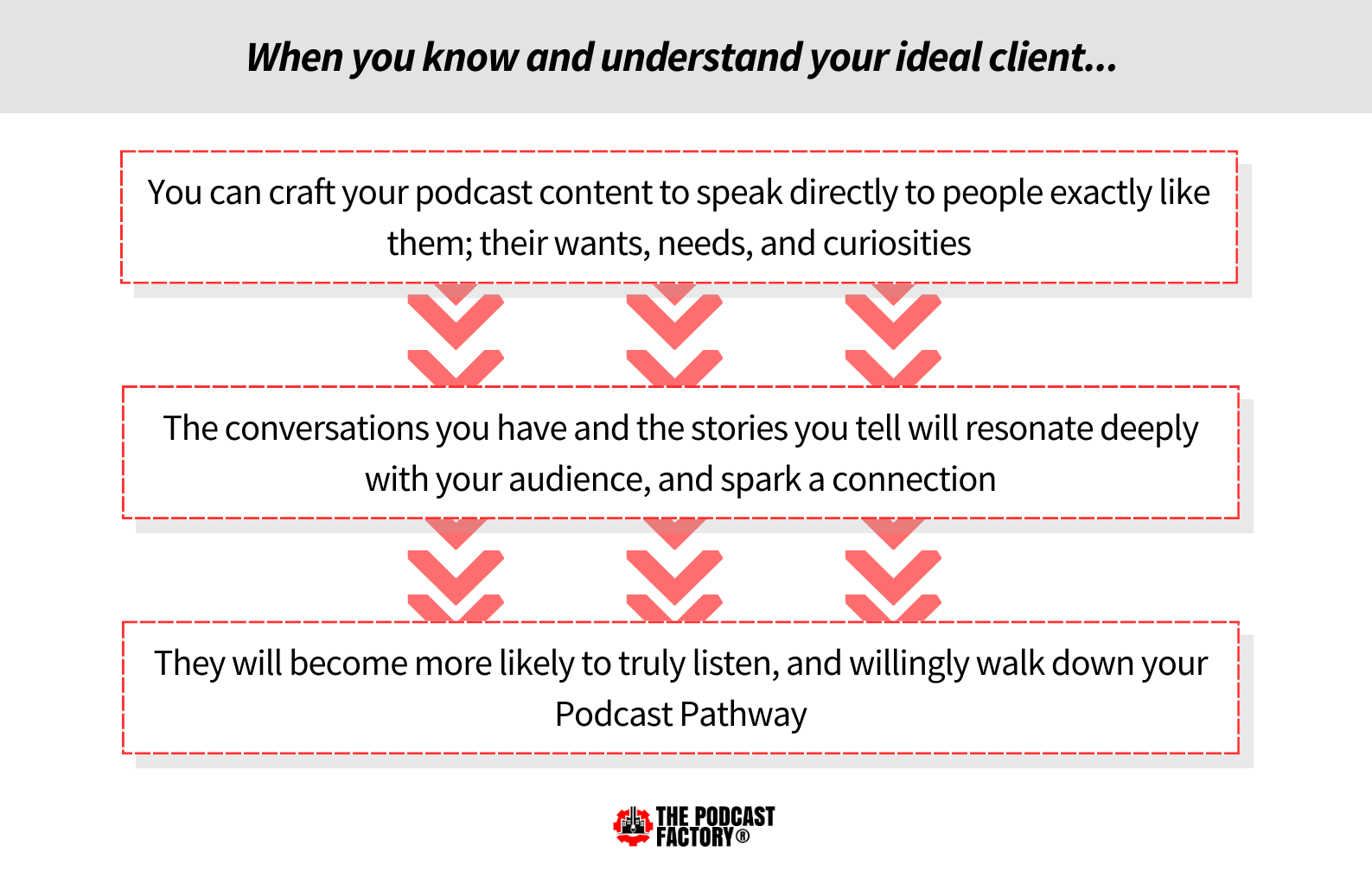
The Client Cloner process is going to look different for each business, but here’s a few baseline tactics that can get anyone started:
The Client Cloner: How To Pinpoint Your Ideal Client
Analyze your pre-existing clients and identify common traits.
Look at their demographic info (age, gender, location, career etc.) and their motivations (why they chose to work with you, what problems they wanted you to solve, what drew them to you).
What traits repeatedly pop up among your existing client base?
Examine your offer, and your motivations – what does this say about your ideal client?
Ask yourself: why do you do this? What problems are you trying to solve with your offer? What gaps in the market does your business fill?
Now relate the answers to your clients:
You do this because you want to help people achieve abc; therefore, abc achievement is your ideal client’s goal.
You see the problems xyz; therefore, xyz is something your ideal client struggles with.
I encourage you to dig deeper with this: don’t stop at just naming the struggles of your ideal client – think about why they struggle with xyz. How does it make them feel? What impact does it have on their day-to-day life?
Note: If you want one-on-one assistance and complete access to my Client Cloner process, you can click here to book a call.
Step 2: The Client Matrix – Decide Where You Want Your Listeners To Go, And How You’ll Get Them There

The second step is what I call The Client Matrix.
This is where you decide what exactly is waiting for your listeners at the end of your Podcast Pathway, and how you’re going to get them there.
Obviously, your ultimate end goal is to turn your audience into clients – but the jump from casually listening to your podcast to booking a call with you can feel like a step too far for some, and you need to plan for that.
Think about it like this: your listeners are blindfolded, and you’re the one guiding them down the Podcast Pathway.
You know exactly where you’re taking them, but they don’t.
Some will put their complete faith in you, and follow along right behind without so much as a second thought.
But most will be overly cautious – and understandably so. They’ll take one teeny tiny step at a time, making sure they’ve got a solid footing before they take the next one.
How you guide your listeners towards your end destination needs to suit both of these approaches; allow the trusting ones to take the big leaps, but also accommodate those taking baby steps.
What these steps look like in the context of your podcast are your calls to action; that is, giving your listeners an action that they can take to further their relationship with you.
A big mistake that podcasters make is to use their podcast as a standalone marketing tool, completely separate from their existing funnel.
This forces their listeners to either take the big leap, or get out – and most do the latter.
Instead, your podcast needs to also link back into your existing funnel, like this:
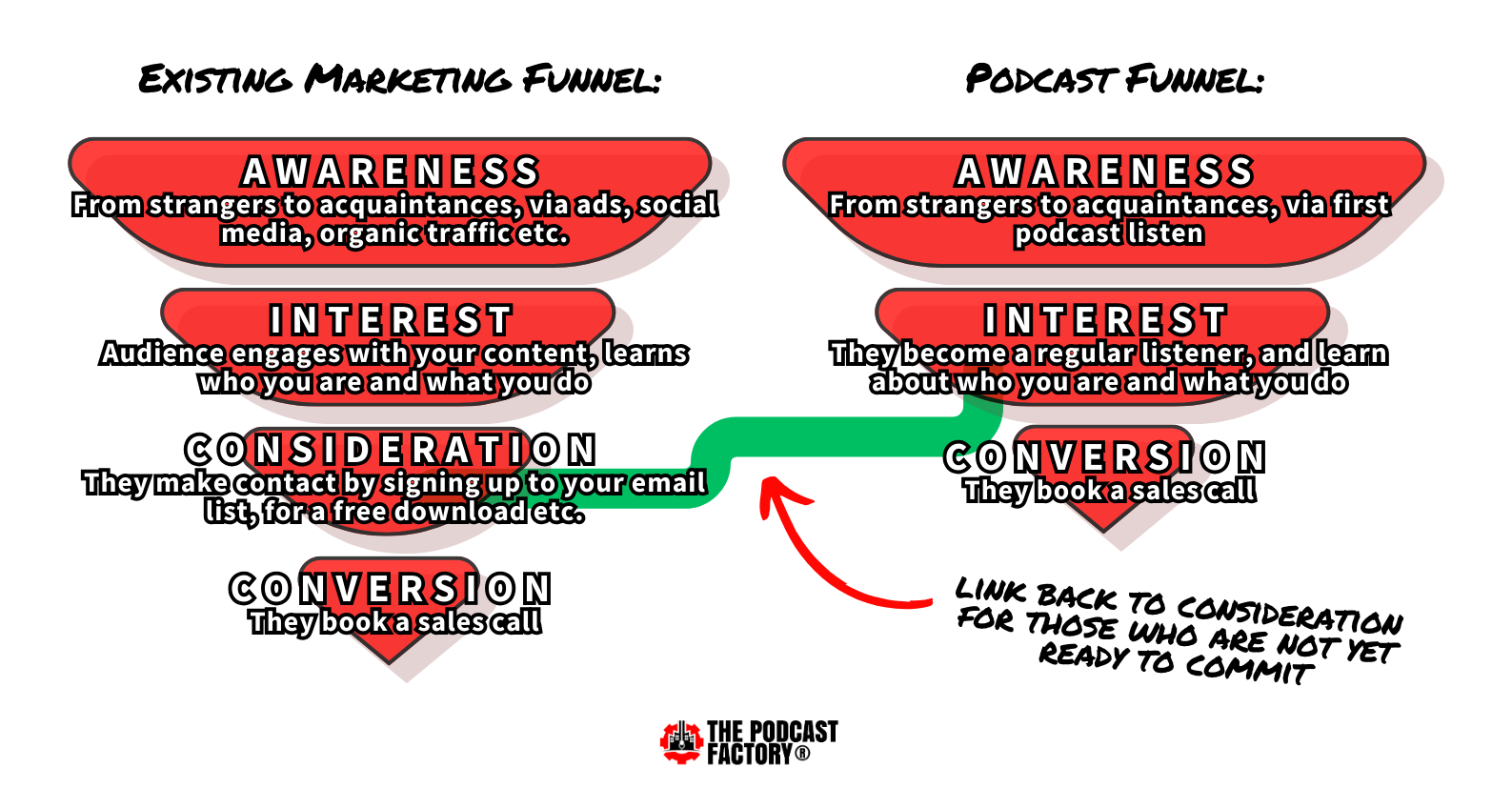
This way, you allow room for both those who are eager to work with you ASAP, and those who are a little more on the cautious side.
The Client Matrix: How To Map The Path To A Sale
I typically recommend to my clients that they include two types of calls to action in their podcast episodes:
- One that takes listeners as close to sale as possible, and
- One that gently nudges them lower into your main funnel.
In practice, this could look something like this:
- Telling listeners that if they want to work with you, they can go to your website and book a call (big leap), and
- Also telling them that they can go to your website, and sign up to receive an instant PDF download (baby step)
The big leap will be pretty much the same for most people – but the baby steps are where you can get really creative.
For example: one of our clients Joe gives the audience his number, and tells them to call if they have any questions – no strings attached.
Joe gets the opportunity to deepen his connections with listeners on an individual level, without the perceived pressure and level of commitment it takes for them to book a sales call.
Another example is Ben, who sells a product rather than a service. He tells his listeners to go to his website, and sign up to receive a free issue of his email newsletter – which is normally $97 per month.
It’s a low-risk action for the listener, they get something of value in return, and it gives Ben more opportunities to market to them in the future via email. Win-win all round!
Step 3: The Content Vault – Identify Roadblocks And Demolish Them With Your Podcast Content
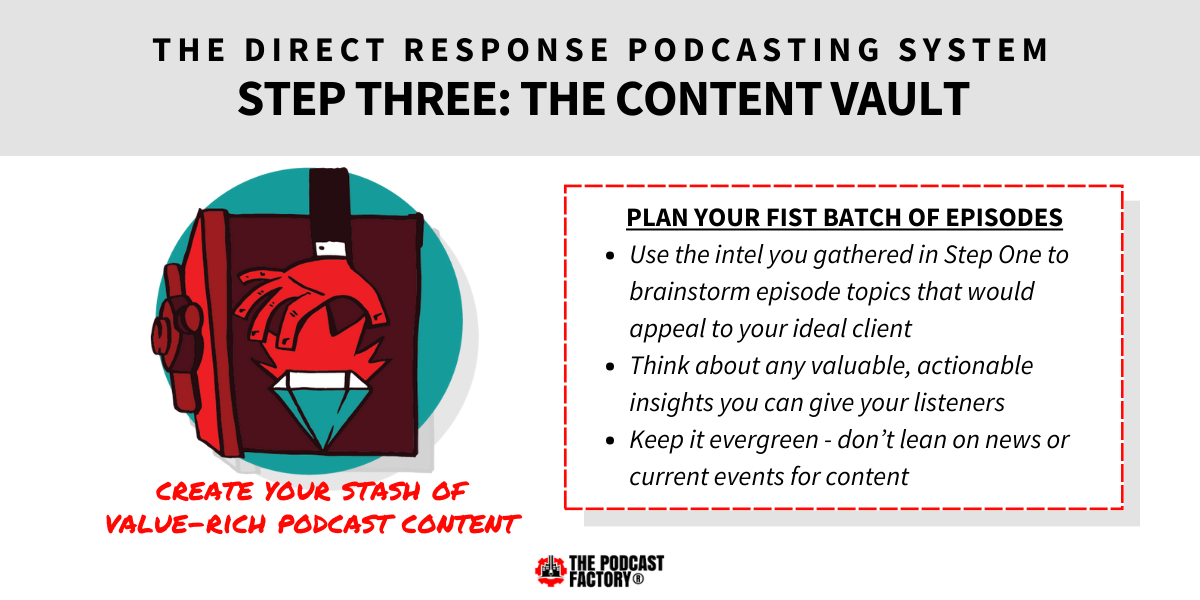
The final step is to deal with that central stretch of your Podcast Pathway, and create a strategy for how you’re going to clear that path.
Be thorough – everything you discover in this step is going to dictate what you build your content around.
This step is where I help my clients build their Content Vault.
Your Content Vault is your first 6 – 8 podcast episodes. It’s the very first impression you’re going to make on your audience, so you gotta make it count.
I help my clients to plan and outline this batch of episodes before they record a single word.
This gives us some breathing space to let the ideas marinate, and ensure each episode pulls its weight and contributes to the larger overall vision; we need to make sure we’re using bulldozers to clear the path, and not flimsy plastic spades.
The aim with The Content Vault is two fold:
1. Knock out objections at the source.
This is where you take everything you learned in Step One, and put it into action. Remember when I said the more specific you can be, the better? This is why.
See, there’s one big mental block that underpins all client objections, and that’s a lack of trust; no trust in you, your capabilities, or even themselves – yet.
And as we’ve already touched on, when you understand your audience, you are more equipped to speak their language.
This means you can showcase your expertise in a way that actually matters to them, earns their trust, and allows their objections to just fall away.
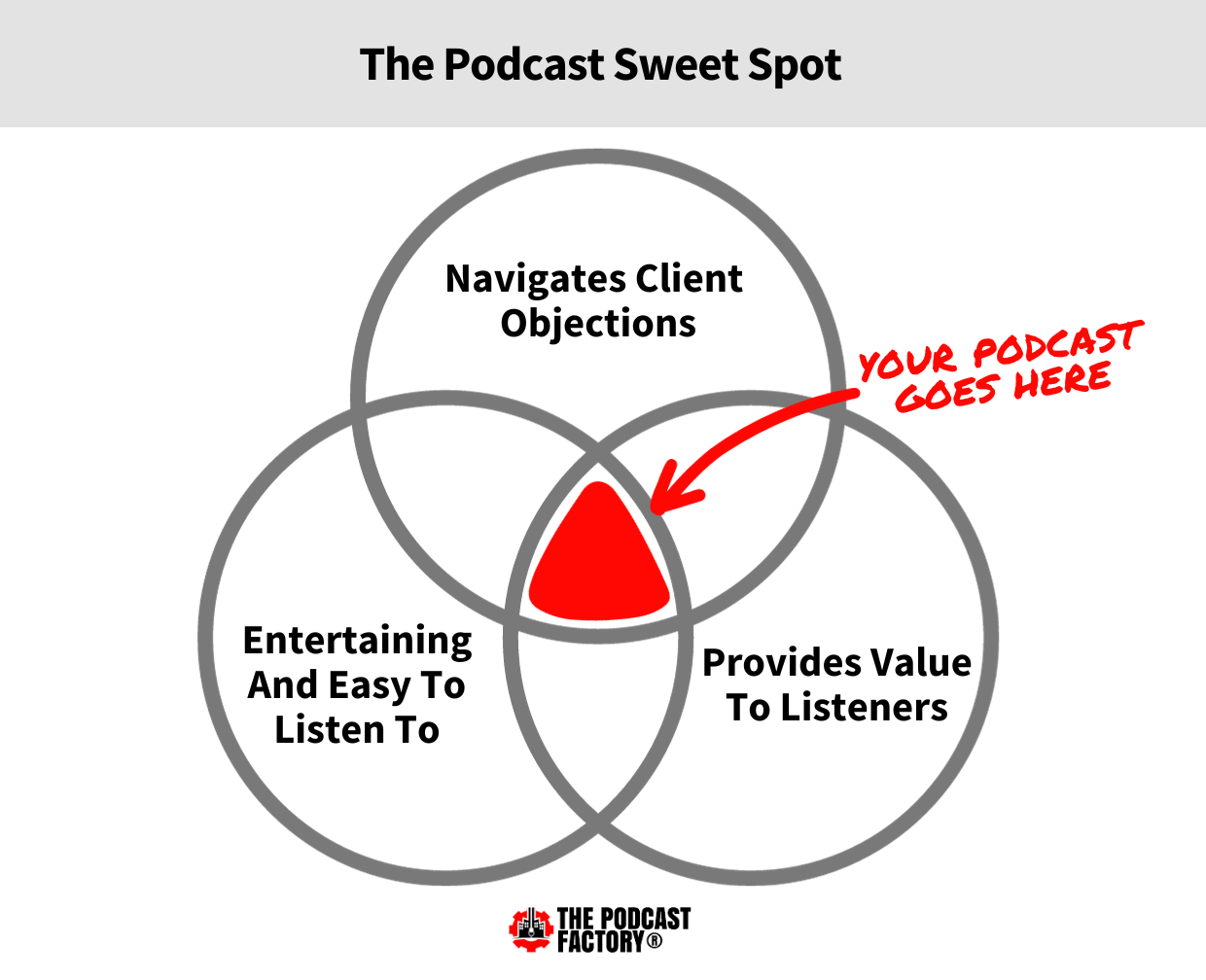
2. Provide your audience with a powerful, valuable resource.
You don’t want your listeners to sit through an episode (or multiple), and feel like they’ve just wasted their afternoon away listening to a big old pile of nothing.
What you do want is to make your listeners feel like they’ve just cracked open a secret supply of highly valuable knowledge and insights that they can actually use.
When you can craft your podcast content to both navigate objections and provide value, you’ll be golden. (bonus points for entertainment and easy listening)
The Content Vault: How To Build Valuable Podcast Content
Go back to Step One, and analyze your findings about your ideal client.
Ask yourself these questions:
- What are the most common problems your audience faces?
- What pain points do they have?
- What are their aspirations?
- What do they want to learn?
Using your answers to guide you, and start brainstorming potential episode topics.
Think about how you can give the audience a small win in each episode. Whether it’s an action or a key lesson to take away, make sure you’re clear on what you want the value to be.
Write it down to keep your mind on track as you’re drafting episode outlines.
Remember: we want this content to be evergreen.
Steer clear of building your episodes around news, current events, and clickbait-esque content – these all have the potential to put an expiry date on your episodes, and depreciate their value into the future.
The Direct Response Podcasting System™ Is Just One Piece Of The Podcast Puzzle
Starting your own podcast is a daunting prospect – the barrier to entry can feel insurmountable for newbies.
And that fear is completely justifiable.
Because, while having the Direct Response Podcasting System™ in your toolkit is a great start, there’s way more to think about than simply the raw content itself.
You need to consider how you’ll record your podcast, choosing equipment, creating cohesive branding of your show, smoothing out those rough edges with high-quality production…
But despite this, podcasting is an incredibly rewarding marketing tool – one that I firmly believe should feel more accessible for business owners like you.
This is exactly what I aim to do with my done-for-you podcast service.
The Podcast Factory: Done-For-You Podcast Service
Unlock the marketing and sales power of podcasting – without the headaches and guesswork.
We offer two packages, depending on your individual needs:
The Red Package
- Strategy: We’ll guide you through the Direct Response Podcasting System™ , and ensure your content sparks a connection and gets your audience clamoring to work with you.
- Branding: We’ll get an idea of the look and feel that you’re aiming for, think about what appeals to your target audience, and bring it all together in your cover art, show name, and intro music.
- Equipment and Software : We’ll set you up with everything you need to record, using a simple equipment checklist.
- Recording: There’s only so much magic that can be done in post-production – so we’ll give you one-to-one instruction on how to record the best raw audio you can, no matter your skill level.
- Production: We’ll edit and produce each episode to make it sound as polished and professional as possible. This includes adding intro music seamlessly, editing out any mistakes or long pauses, and including any extra voice overs. All you have to do is send over your raw audio, and we’ll smooth out the rough edges for you.
- Publishing: We’ll make sure your podcast can get into as many ears as possible by publishing it on all major platforms, including Apple Podcasts, Google Podcasts, and Spotify.
- Marketing: We’ll give you an entire team dedicated solely to squeezing as much value as possible out of your podcast by turning it into written and visual content. Some of our clients have gotten weeks of content out of just one episode.
The Black Package
The Black Package includes everything you see in The Red Package, plus two exclusive extras:
- The Client Cartels System: Our secret strategy for taking everything you’ve learnt today, and cranking the dial up to 100. We’ll get you guests, book the calls for you and show you how to supercharge your potential for client connection through the power of interviews.
- Cinderella Scoring System: This is our foolproof method for filtering your potential clients. We’ll teach you how to use our scoring system to guarantee you will only ever work with those who are a perfect-fit for your business.
Interested, but not sure which package is for you? Click here to book a call. I’ll get to know you and your business, so we can discuss which package is best suited to your specific needs and aspirations.
Final Thoughts
Connection with your market is an invaluable resource. When you manage to do it effectively, it can absolutely skyrocket your profit generation.
And I think deep down, everyone understands how podcasts facilitate this connection, and therefore how much their business could benefit from starting one.
But they ignore that potential out of fear of failing.
It’s a story I hear with my clients, over and over again: “I always had an idea for a podcast, but I didn’t know where to start”, “I was worried no one would listen” , “I was scared no one would care”.
And every single time, these clients worked with me and my team, and realized that their fears were completely unfounded.
Because they did have something valuable to say. They did have an audience that would listen, learn, and connect.
They just had to find them.
There was a small detail in that post from Mark’s client that I haven’t touched on yet:
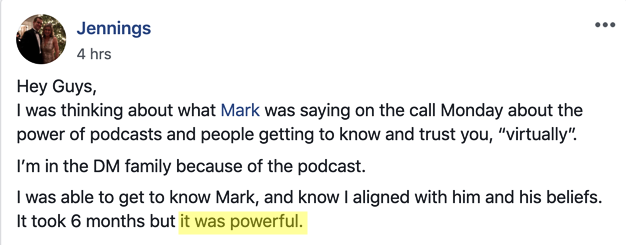
It was powerful.
Mark has been able to use his podcast to create connections, take new clients under his wing, and transform their lives.
And I firmly believe that you can too.
If you want to talk to me and discuss exactly how The Podcast Factory team can help you do that, you can click here to book a call.